
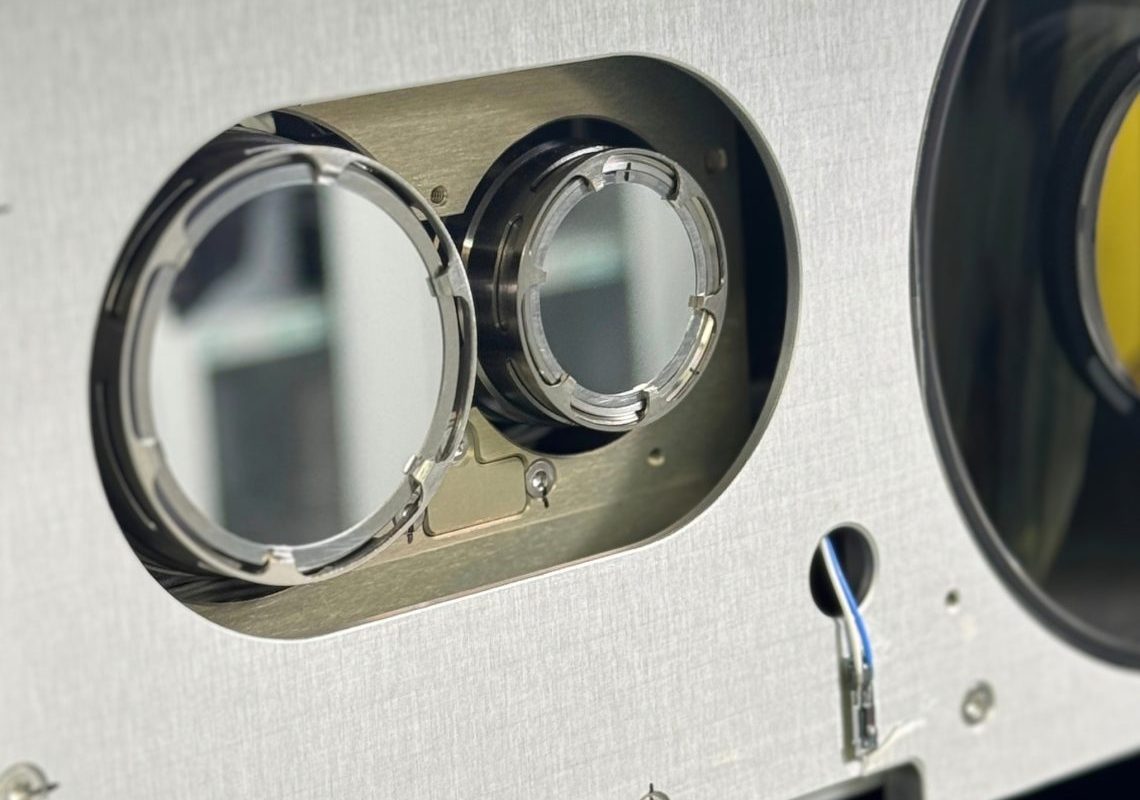
Lithuanian space and defence technology company Astrolight, together with its partners in Greece, has successfully commissioned a laser communication system capable of transmitting data from an orbiting satellite to a ground station. This marks the first time Astrolight’s laser communication technology has operated in orbit and enabled routine data transmission to Earth. The system now operates autonomously, with both the satellite terminal and ground station managed remotely from Lithuania.
The achievement was announced on 8 October by Astrolight, together with the National and Kapodistrian University of Athens and Aristotle University of Thessaloniki.
Data Transmission at 1 Gbps
The laser communication link was established between two Astrolight-developed systems: the ATLAS-1 laser communication terminal installed aboard a satellite and an optical ground station in Greece. ATLAS-1 is integrated into ERMIS-3, a nanosatellite developed by the University of Athens, while the data is received by Aristotle University of Thessaloniki’s HolOGS-1 optical ground station, located in the Holomondas Mountains in Greece. Astrolight upgraded the station to its OGS-2.5 configuration. Both systems were developed as part of the ERMIS and PeakSat missions, supported by the European Space Agency (ESA).
The system currently transmits data at 1 gigabit per second (Gbps), while technical assessments conducted by the company indicate that it could support speeds of up to 10 Gbps. The first optical link was successfully established during the satellite’s first active pass over the ground station. By the third pass, both systems had been fully calibrated and began operating autonomously according to a predefined schedule. Within a week of the initial connection, the system had transitioned to routine operations, with communication links now established twice daily and both systems managed remotely from Lithuania.
One of the most significant aspects of this achievement is not only the successful transmission of data using laser technology, but also the system’s demonstrated ability to establish and maintain optical links autonomously. According to Astrolight, reliable communication was achieved during both daytime and nighttime operations, including under more challenging conditions when the satellite was low above the horizon or when clouds and other obstacles intermittently obstructed the optical path. Following in-orbit calibration, optical link availability exceeded 85% during satellite passes with elevation angles above 15 degrees. When the optical link was interrupted, ATLAS-1 was able to re-establish communication in less than 10 milliseconds without requiring an additional scanning procedure.
According to Dalius Petrulionis, Co-founder and Chief Technology Officer of Astrolight, the company is among the first to demonstrate a fully autonomous end-to-end laser communication link using its own systems in both space and on the ground, operated entirely remotely. Astrolight aims to make high-speed optical communication a practical, routinely available service for satellite operators without the need for continuous on-site supervision.
Laser Communication as an Alternative to Radio-Frequency Data Transmission
Most satellites currently transmit data to Earth using radio-frequency communication. Laser communication offers an alternative, enabling large volumes of data to be transmitted through a narrow optical beam. One of the technology’s key advantages is its resistance to radio-frequency interference. In addition, the narrow laser beam makes interception of transmitted data more difficult, while optical communication technologies offer the potential for significantly higher data transmission rates. These capabilities are becoming increasingly relevant as satellite data volumes grow and demand rises for reliable, high-speed and secure communication solutions.
Laurynas Mačiulis, Co-founder and CEO of Astrolight, highlights that electronic warfare threats, GPS interference and the vulnerability of communication infrastructure are increasing the importance of alternative communication technologies. He emphasises the need for Lithuania and Europe to develop solutions that are resistant to radio-frequency interference and reduce dependence on individual elements of communication infrastructure.
Next-Generation Laser Communication Systems
Following the successful commissioning of ATLAS-1 and OGS-2.5, Astrolight continues to develop its space-to-ground laser communication technologies. In addition to the operational optical ground station in Greece, the company is building another station in Greenland in cooperation with the European Space Agency. Astrolight is also developing three next-generation laser communication terminals: ATLAS-2, ATLAS-X-MINI and ATLAS-X.
ATLAS-2 and ATLAS-X-MINI are being designed to support communication speeds of up to 2.5 Gbps for inter-satellite and space-to-ground links. Certain configurations of these terminals could potentially achieve speeds of up to 100 Gbps. The larger ATLAS-X terminal is being developed to support data transmission rates of up to 400 Gbps in accordance with the ESTOL standard. Its commissioning is planned for 2028–2029 as part of ESA’s HydRON project, while qualification testing of ATLAS-2 and ATLAS-X-MINI is expected to be completed in 2026.
The successful operation of ATLAS-1 in orbit marks an important milestone in Astrolight’s technological development. Laser communication systems developed in Lithuania are now being used for routine data transmission from space to Earth, providing a foundation for further technological advancement and commercial applications.
Source: