
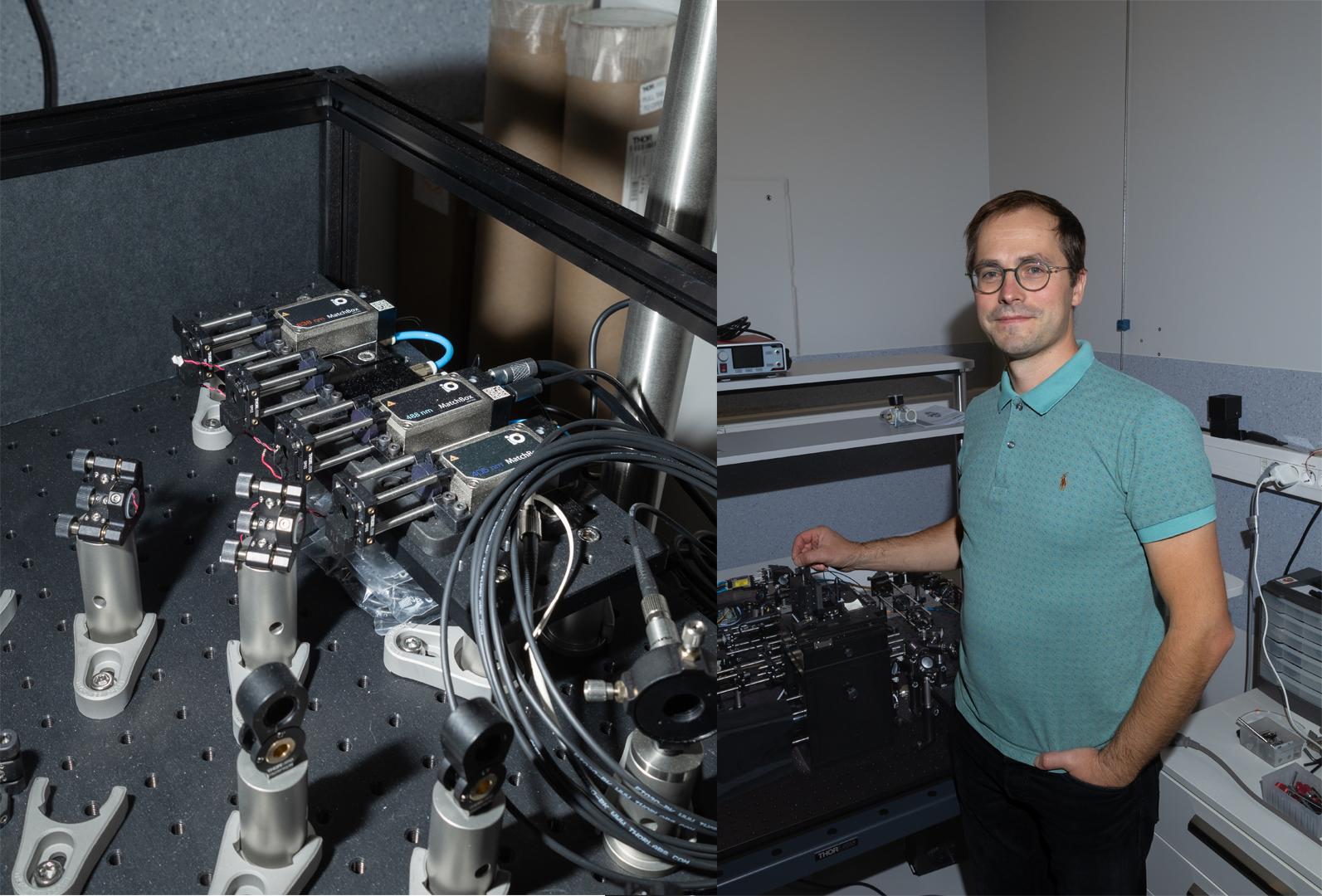
A team of researchers from the Life Sciences Center at Vilnius University, led by Assoc. Prof. Dr. Marijonas Tutkus, has developed “miEye”, an ultra-high-resolution fluorescence microscope capable of studying biological structures at the single-molecule level. To the researchers’ knowledge, it is the first fully operational microscopy system of its kind in Lithuania to be used for routine research. Lasers developed by Lithuanian manufacturer Integrated Optics played an important role in its development.
Exploring the World of Single Molecules
The resolution of conventional light microscopy is limited by the diffraction of light, making it difficult to distinguish extremely small structures located close to one another. Single-molecule localization microscopy (SMLM) overcomes this limitation, enabling researchers to obtain significantly more detailed images of biological structures.
This technique involves detecting signals from individual fluorescent molecules, precisely determining their positions, and reconstructing a super-resolution image from thousands of such measurements. It allows scientists to investigate cellular structures and the spatial distribution of molecules at a level of detail that conventional light microscopy cannot achieve.
The “miEye” system developed by Vilnius University researchers makes it possible to perform such experiments in Lithuania using equipment designed, built, and tailored to their specific research needs.
From an Open-Source Project to a Fully Functional Microscope
The development of “miEye” began in 2020, when Dr. Tutkus received funding from the Research Council of Lithuania for a scientific research project. One of its objectives was to develop an advanced microscopy system that would meet the laboratory’s research needs while remaining within the available budget.
Rather than purchasing a commercial microscopy system, the research team decided to build one themselves. They based their design on “miCube”, an open-source project developed by researchers in the Netherlands, and extended it with their own solutions.
One of these was an autofocus system designed to maintain stable focus during long experiments. The team also developed “microEye”, Python-based microscope control software, which they released as an open-source project.
As a result, the researchers created not only a fully functional instrument but also a flexible experimental platform that can be further developed and adapted to new research applications.
Lithuanian Lasers – a Key Component of the System
One of the main challenges in developing “miEye” was selecting suitable laser sources. Super-resolution fluorescence microscopy requires stable lasers with sufficient output power and a range of wavelengths. These lasers must also be compatible with other optical components and the microscope’s control system.
The researchers selected “MatchBox” lasers manufactured by the Lithuanian company Integrated Optics. Their compact design made it possible to integrate multiple laser sources into a limited space, while the open software control interface allowed the lasers to be directly integrated with the team’s “microEye” software.
The “miEye” system incorporates lasers operating at different wavelengths across the 405–830 nm range. They serve different purposes: some are used to excite fluorescent molecules, while the 830 nm laser is used for the autofocus system. Multiple excitation wavelengths enable researchers to work with different fluorescent labels and perform multicolour microscopy experiments.
Cost was another important consideration. The selected lasers enabled the researchers to develop a more versatile system without compromising on other components essential to their experiments. Over several years of collaboration, the team has incorporated nearly ten Integrated Optics laser products into its systems and is currently developing a second laser module.
“Collaborating with researchers who develop their own systems is one of the ways we improve our products. Only the end user can identify specific needs that we might not have anticipated ourselves. Their solutions and experience directly influence the development and improvement of our products. Marijonas Tutkus and his team’s project is an excellent example of this,” says Evaldas Pabrėža, CEO of Integrated Optics.
New Opportunities for Scientific Research in Lithuania
Today, “miEye” is already being used as a routine research instrument. According to its developers, it is the first fully functional SMLM microscope of its kind in Lithuania, enabling researchers to conduct super-resolution microscopy experiments in their own laboratory.
The significance of this achievement goes beyond the technical capabilities of the instrument itself. Having developed the system in-house, researchers have greater freedom to modify it, explore new experimental methods, and adapt the equipment to address specific scientific questions.
The story of “miEye” also highlights the broader potential of Lithuania’s high-tech ecosystem. Laser technologies developed in Lithuania are exported to research laboratories and industrial companies around the world, while also contributing to the development of new scientific capabilities at home.
Read more about the development of “miEye” and the application of “MatchBox” lasers in the case study published by Integrated Optics.
Building on this experience, Integrated Optics has developed ARA, a four-wavelength laser module (405, 488, 561 and 638 nm) that integrates all four excitation sources into a compact 65 × 40 × 10 mm housing, enabling OEM customers and researchers to further reduce the size of their instruments.